South Korea is looking beyond today’s technology race and placing major bets on the industries that could define the next few decades.
The country has unveiled an ambitious national strategy focused on seven future technology sectors, including nuclear energy, fusion, renewable power, quantum technology, space, biotechnology and advanced materials.
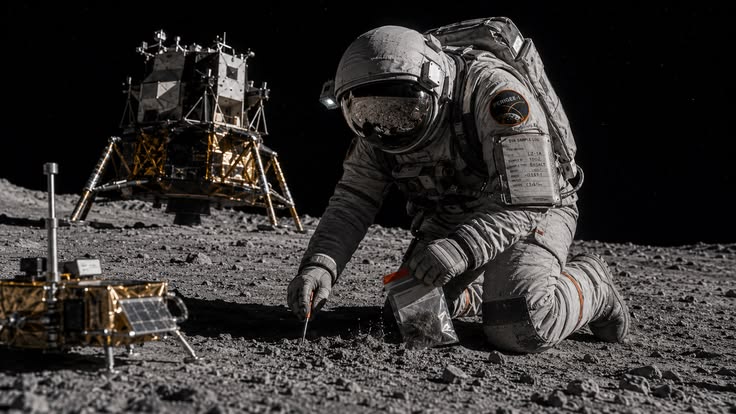
Among the targets are plans for a domestic moon landing by 2030, a 100-qubit quantum computer by 2029 and the commercialisation of brain-computer interface products by 2035.
The strategy reflects a growing global competition around what might be described as “the technologies after AI”.
Artificial intelligence and semiconductors dominate today’s technology headlines.
But governments are increasingly preparing for the next set of industries that could reshape economies.
Quantum computing could transform scientific research.
Biotechnology could change medicine and agriculture.
Space technology could become a major commercial industry.
New energy systems could reshape how countries power their economies.
South Korea already has major strengths in areas such as electronics and semiconductors.
The country’s new strategy is designed to ensure it remains competitive as the technological landscape changes.
The moon mission is perhaps the most symbolic target.
For decades, space exploration was dominated by a relatively small number of countries.
That is beginning to change.
Private companies are entering the industry.
New national space agencies are being established.
Countries that previously focused on satellite technology are now developing more ambitious plans for lunar exploration.
South Korea’s goal of landing on the Moon by 2030 would place the country among a growing group of nations attempting to establish serious space exploration capabilities.
But the strategy is about more than prestige.
Space technology is increasingly connected to communication, navigation, Earth observation and national security.
Satellites have become part of the infrastructure that supports the modern economy.
Countries that develop strong space capabilities could gain important advantages in the future.
Quantum technology is another major focus.
Traditional computers process information using bits that represent either zero or one.
Quantum computers use quantum states, allowing information to be processed in fundamentally different ways.
The technology could eventually become particularly valuable for complex scientific problems involving chemistry, materials and optimisation.
However, building useful quantum computers remains extraordinarily difficult.
Quantum systems are sensitive to noise and errors.
Creating a machine with more qubits does not automatically make it more useful.
The challenge is developing systems capable of performing reliable calculations.
South Korea’s 100-qubit target is therefore part of a wider global competition involving governments and technology companies across North America, Europe and Asia.
The country’s future strategy also includes biotechnology and brain-computer interfaces.
These technologies could eventually change the relationship between humans and machines.
Brain-computer interfaces aim to create systems capable of translating neural signals into actions performed by computers or other devices.
Early research has already demonstrated the potential for such systems to assist people with certain physical disabilities.
Future commercial applications could become much broader.
South Korea’s plan to pursue these technologies demonstrates how quickly the definition of a “technology company” could change.
The biggest companies of the future may not necessarily make smartphones or social media platforms.
They may build energy systems, quantum machines, biological technologies and space infrastructure.
The countries preparing for that future are investing today.
South Korea’s strategy is one example of a wider global shift.
The next technological revolution may not arrive from one invention.
It may emerge from several scientific fields advancing at the same time.
And the countries building expertise across those fields may have a significant advantage when the future finally arrives.