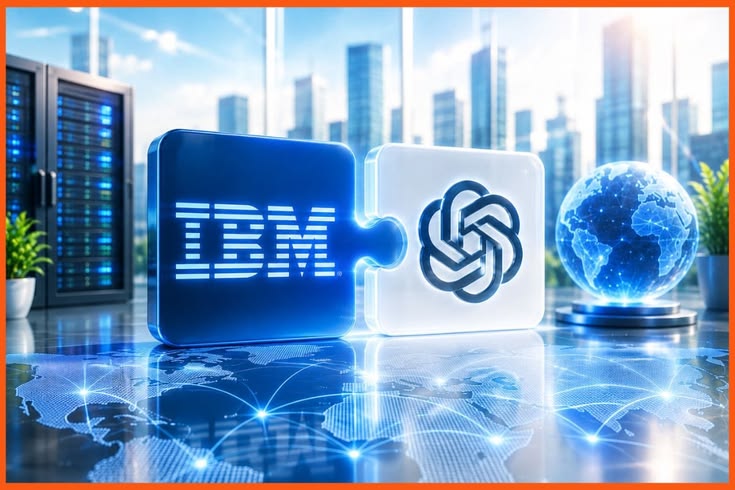
IBM and OpenAI are joining forces in a new partnership aimed at bringing artificial intelligence deeper into the everyday operations of large businesses.
The companies announced plans to combine OpenAI’s AI models and products with IBM Consulting’s technology and enterprise expertise, with a focus on areas including workflow automation, application modernisation and AI risk management.
The partnership reflects a shift taking place across the AI industry.
Businesses are no longer simply experimenting with chatbots and asking whether AI can generate useful answers. Increasingly, the focus is moving towards a more difficult question: can AI actually become part of how companies operate?
IBM believes the answer will increasingly involve AI agents.
Unlike a traditional chatbot that responds to individual prompts, an AI agent can potentially complete tasks across several stages. It might analyse information, interact with software, make decisions within defined limits and pass work to another system.
IBM plans to use OpenAI’s models alongside its own consulting services to help companies build those kinds of systems.
OpenAI’s frontier models, as well as products including Codex and ChatGPT Work, are expected to be integrated into IBM Consulting Advantage, the company’s AI platform for delivering consulting services.
For IBM, the partnership gives the company access to some of the world’s most advanced AI technology while allowing it to focus on something that has long been central to its business: helping large organisations implement complex technology.
For OpenAI, it provides another route into the enterprise market.
Many major companies want to use generative AI but remain concerned about security, compliance, data protection and the difficulty of connecting AI systems to existing software.
That is where established enterprise technology companies such as IBM can play an important role.
The partnership also highlights how competitive the enterprise AI market has become.
Microsoft, Google, Amazon and other technology companies are all racing to become the infrastructure behind the next generation of AI-powered businesses.
But simply having a powerful model may not be enough.
Companies also need help integrating AI into older software systems, training employees and managing the risks that come with increasingly autonomous technology.
IBM and OpenAI are betting that enterprise customers will want both.
The deal suggests that the next stage of the AI boom may be less about which company has the most impressive chatbot and more about which companies can turn artificial intelligence into something businesses can actually depend on.
That transition could prove to be one of the biggest opportunities in the technology industry over the next few years.